Thoughts on the ocean, the environment, the universe and everything from nearly a mile high.

Panorama of The Grand Tetons From the top of Table Mountain, Wyoming © Alan Holyoak, 2011

Friday, August 24, 2012

Are you kidding me!? Arctic sea ice melt is already at a near record level and still going strong

In 2007 the rate and extent of sea ice melt shocked the world of climate scientists.  That year an unusual set of weather events combined to produce a record sea ice melt in the Arctic Ocean.  This year, 2012, that record is almost certainly going to be broken, if not shattered.  What makes this VERY unusual is that the recent conditions in the Arctic, including an Arctic cyclonic storm, normally produce slower sea ice melt conditions, not the record-pace conditions observed over the past several weeks.

The National Snow and Ice Data Center and NASA show that as of yesterday (8-23-2012) the sea ice extent in the Arctic Ocean is already at near record levels. 

This map shows the current area of the Arctic Ocean covered by at least 15% sea ice as of 8-23.

If you follow my blog you've certainly seen maps like this before.  The white area shows sea ice cover, while the orange line shows the historical average (1979-2000) sea ice cover for this date.  As you can see, the amount of sea ice currently existing in the Arctic is WAY below average, and it has been for the past several years. 


What makes this year different, however, is the rate and extent of sea ice melt - it's going crazy!

Normally the Arctic reaches maximum sea ice melt sometime in mid to late September.  The graph below shows some interesting things.  The dark gray line shows the historical rate of Arctic sea ice melt (1979-2000).  The light gray area aound that line shows + 2 standard deviations (i.e., the range that contains 95% of all sea ice extent observations during that 1979-2000 time period).  The dashed green line shows the pattern of sea ice melt during the previous record year, 2007.  The blue line shows the pattern of sea ice melt this year, 2012. 


As you can see, the sea ice extent in the Arctic is already within a hair's breadth of setting a new sea ice melt record.  That this would happen is not a surprise to climate scientists anywhere...what IS a surprise, though, is how early we reached this mark this year.  We are still anywhere from two to three weeks from the date when we observe the maximum sea ice melt for a given year. 

As for the record for this date, the sea ice melt for 2012 is somewhere between 500,000 km2 and 750,000 km2 greater (that's that much less ice) than in the previous record year of 2007!  Only time will tell now by how much the old record will be broken, but if this year's pattern holds it could be more than a record-breaking year, it could be a record-smashing year.

I'll keep you posted as the melt season progresses.

Friday, August 17, 2012

Have we passed a tipping point? 2012 Arctic sea ice melt is going like mad!

I don't have long, but I just want to get this out there.  When I checked in with the state of the Arctic Ocean sea ice melt I was surprised and shocked to see that the sea ice extent is rapidly closing in on the record sea ice melt observed in 2007.  That the 2007 record would be broken eventually is not the surprising thing.  The  surprising thing is that we are still weeks away from the traditional sea ice minimum (1979-2000 data) and nearly a month from the 2007 sea ice minimum date near mid Sept.

Who knows how much sea ice cover we are likely to lose before mid-Sept?

By my rough calculations based on this map, the 1979-2000 baseline sea ice extent for this date is 7.75 million square kilometers, the previous record for this date (in 2007) was about 5.3 million square kilometers, and the current observed sea ice extent is about 4.8 million square kilometers!  That's half a million square kilometers of sea ice LESS than we observed during the previous record set in 2007.

The 2012 data represent only one year's observation, and as such does not constitute  trend, but the rapidity of this year's melt, together with an Arctic cyclonic storm that normally tends to slow sea ice melt that instead accelerated it, gives me reason for concern.  (For more info on this, visit http://nsidc.org/arcticseaicenews/).

North America has had record heat through the spring and summer of 2012, a massive Greenland ice sheet has been reported that is well beyond anything previously observed, and eastern Europe and other regions of the world also report much warmer than average temperatures.

Unless there is a drastic change in Arctic conditions in the next few days we will almost certainly see a new record sea ice melt in the Arctic Ocean.

The good news is that a recent report from the United States Energy Information Administration (http://www.eia.gov/todayinenergy/detail.cfm?id=7350) stated that national CO2 emissions through the early part of 2012 were down to the level of 1992 emissions - mainly due to power plants switching to available, cleaner burning natural gas.  Still, this concerns me, because with even this reduction we are seeing record temperatures, etc.  I am hopeful, though, that this trend of decreased emissions will continue and mitigate climate change, if possible.

So I pose the question, have we passed a tipping point?  Only time will tell...

Tuesday, August 7, 2012

Global Climate Update - summer 2012

I know that you're probably miffed at me because I've been slacking off for the past couple of weeks, and I haven't given you any Arctic sea ice or national or global climate updates.  Well, everyone deserves a break, but now that we managed to survive July, and some of the agencies and labs that track climate trends have reported in, it's time to take a look at what's going on out there.

First of all...IT'S HOT OUT THERE!

This map shows the global temperature anomalies for June 2012 compared to a long-term average of temperature data from 1971-2000.  The bigger the red circle, the hotter it is compared to the historical average, and the bigger the blue dot the cooler.

Yep, almost everywhere, especially almost everywhere on land, is hot!  And in most of the high north latitudes as much as 4-5oC hotter than the historic average.  Localized weather conditions are keeping a few places, like Australia, central Africa. and the North Pacific cooler than usual, but everywhere else it's hot, dang hot!

Yeah, like you needed a map from NOAA (The National Oceanographic and Atmospheric Administration) to tell you that.

Next let's take a look at the United States drought index.  This map is provided courtesy of the USDA (Dept of Agriculture and other govt. agencies that track weather, climate, and their effects on agriculture.

This map shows that state of drought conditions across the United States as of 31 July 2012.  Yep, the darker red the color, the more intense the drought.  Scarily, the most intensive drought conditions stretch across the country's bread basket of the Great Plains states.


I just talked with my folks who live in Wichita, KS, and they say that the corn around there is in REALLY bad shape.  They told me that the leaves are dry and brittle, just hanging down on the stalks.  They also told me that while traveling to Oklahoma City recently that they saw a thermometer that said 118oF!  Yow!  

Only the Pacific NW and isolated parts of other states seem to be spared this year's summer drought.

All right, let's see what's brewing up north - our "canary in a coal mine" for global climate.

First stop - Greenland.  This graph from the National Snow and Ice Data Center (NSIDC.org) shows a disturbing development.  The puple-ish area at the bottom of the graph shows the historical average including data from 1980-1999 of ice melt area on Greenland.  The other colors show observed ice melt in 2010 (blue), 2011 (green), and 2012 (red) through the middle of July.  This year the ice melt area has shot off the charts, uncovering between 4-5x the normal amount of land area uncovered by melting ice.  Other data (not shown here) show that Greenland's ice cap is getting thinner around the edges and thicker in the middle, but that all in all ice is melting faster than it is being added.  The bottom line?  The Greenland ice cap is starting to shrink.
OK, what about the Arctic Ocean 2012 spring and summer sea ice melt?  The graph below shows the historical average amount of ice melt from the years 1979-2000, and the ice melt trends for 2007-2012.  The ice melt in 2007 was the most extreme recorded so far, but if you look at the graph again you will see that the sea ice melt trend for 2012 is nearly identical to that seen in 2007 at this point in the year (8-5-2012).  There is no way to know if this rapid rate if ice melt will continue, but if it does we may well be looking at a new record sea ice melt.  It is, at least, but not by much, the record for Arctic sea ice melt for this date.

The amount of sea ice remaining in the Arctic ocean is currently about 2 MILLION square kilometers less than the 1979-2000 historical average.  Now that's worth noting.

This map shows the current extent of sea ice cover (at least 15% cover) in the Arctic Ocean.  The NW Passage has opened up again west of Baffin Island, and sea ice melt is greatly ahead of historical trends (the orange lines) north of most of both Alaska and Siberia.  OK...so what?
  

This graph shows what has become a predictable trend of decreasing sea ice cover.  July 2012 is a close second to 2011 as the all-time lowest sea ice cover for this month.  The downward trend of sea ice cover, i.e., increasing trend of sea ice melt continues...


Climatologists who study the patterns and processes of climate and climate change developed a set of scenarios regarding Arctic sea ice melt.  This graph shows two scenarios starting in 1900 and running through 2100.  The blue line indicates a scenario of "business as usual" greenhouse gas emissions, and the red line represents an updated scenario based on an improved model, but the black line, that represents observed sea ice extent data for the month of September 1952-2011 shows sea ice cover declining at an even faster rate than even the latest model scenario.

How different are the observed data and the model scenarios?  The original "business as usual" model scenario indicates that the sea ice melt over the past few years is happening 40-50 years sooner than the original scenario showed.  And the observed sea ice melt is still proceeding 10-20 years faster than the newer model suggests should be happening.


No matter how you slice it, it's warmer out there now than it used to be.  It's warmer on land, ice is melting faster on Greenland, and sea ice is melting faster in the Artctic than it used to.  The bottom line is that, believe it or not, like it not, the global climate is changing - warming.

One last thing...what about the Antarctic?  Sea ice formation and melting appears to be proceeding normally there, but this is south polar pattern is maintained due to unique currents and oceanographic factors around the Antarctic continent that keep it colder than anyplace else on the planet.  In short, the Antarctic East Wind Drift Current and Antarctic West Wind Drift Current create the Antarctic Divergence that keeps supercooled water inshore AND moves supercooled water north away from Antarctica.  This supercooled water is denser and will not readily mix with the warmer, less dense water masses found in the southern Indian, Atlantic, and Pacific Oceans.  So the Antarctic is the exception to what is happening globally.  But to explain this more fully would require another complete posting.  

Saturday, July 14, 2012

Drought and High Temperatures: Things are Getting Bad in America's Breadbasket

Farmers in The Great Plains and the Ohio River Valley were looking forward to a bumper drop this year.  That was earlier this spring when unseasonably warm weather allowed them to get into their fields earlier than usual, and the crops got an incredible jump start on the growing season compared to years past.  But that didn't last...the rain stopped coming.

This is a video from NOAA (The National Oceanographic and Atmospheric Administration) showing the progression of drought and heat stress on American crops.


If you click this link you can see a report from Weather.com featuring farmers and their concerns and situations: Weather Channel Short Report on Current Drought.

According to my folks who live in Kansas, earlier this spring the wheat harvest was as much as three weeks ahead of schedule, and farmers across America's breadbasket were reporting the same thing - corn, soy, wheat, etc.

Then a drought settled in.  It has been warmer than normal and drier than normal across huge areas of the Nation.

This map from the National Climatic Data Center of NOAA (the National Oceanographic and Atmospheric Administration) shows temperature ranks, state by state, across the country.  A score of "118" means it's the warmest Jan-June average temperature ever recorded.  Just about everyplace except the west coast had either record high temperatures or much higher than normal temperatures.


It's also a LOT drier than normal through the breadbasket of America.  The Ohio River Valley and the SW are dry, dry, dry.  A score of "1" indicates the driest Jan-June ever.


The map below shows state by state precipitation ranks for the month of June 2012 compared to all previous Junes since the late 1800s.  Wyoming is tinderbox dry, as is most of the rest of the mountain west, and the Midwest is also suffering terrible drought.


It's a terrible thing.  Pray that the rains return, and quickly.

These high temperatures and drought conditions are short-term weather events, but they are generally consistent with climate change scenarios climatologists have predicted for years.  It is statistically difficult to tie a particular weather event to climate change, but one thing is highly certain, that is that the overall trends of observed global climate change over the past few decades make these kinds of weather extremes more likely to occur.

Friday, July 13, 2012

Arctic Sea Ice is Melting Freakishly Fast - July 13th 2012

I know, I know, ANOTHER posting on Arctic sea ice!?  No, it's more than that.

I guess I just can't help myself, plus the sea ice melt is currently on record pace.  The all time record Arctic sea ice melt so far occurred in 2007, but right now there is somewhere between 250,000 and 500,000 square kilometers more open water in the Arctic today than there was at this time in 2007!

The melt is really taking off north of Siberia, in Baffin Bay west of Greenland, and in the Beaufort Sea  north of the Canadian Yukon, Northwest Territories, and eastern Alaska.  Plus Hudson Bay will soon be ice free, well ahead of historical average melt dates.  If this keeps up we will see a new record for ice melt in the Arctic later this summer.  


This graph shows the comparison between the area of sea ice cover in the Arctic Ocean between historical averages (1979-2000 - dark gray line), the 2007 record sea ice melt year (dotted green line) and current sea ice cover (blue line).

OK, so what?  What can we do to mitigate what is going on with global climate change.  While I encourage everyone out there to drive less, walk or bike more, and emit as little carbon as possible, the bottom line is that as individuals we can do little to mitigate the problem.  What is desperately needed NOW is for everyone to put pressure on their local, state, and national leaders to take steps to mandate change.  It's clear that the small grassroots effort that has been going on for the past few decades is not going to do the job.  We need large-scale investment in cleaner, more efficient energy, reductions in carbon emissions, and transportation options.

The science is in, and no matter how much nay-sayers or skeptics want to think or say otherwise, humans are driving the current trend of global warming.
The National Oceanographic and Atmospheric Administrations's Climatic Data Center just released data showing that the months of January through June of 2012 was the warmest ever in the 118 year history of national weather statistics.

This map shows state-by-state rankings of average temperature compared to all other years of Jan-June temperature averages since the late 1800s.  A score of "1" means it was the coldest average temperature in the record.  A score of "118" means it was the warmest in the temperature record.

This map shows that only two states, Washington and Oregon, showed near normal average temperatures, while the rest of the country experienced above normal to record warmest temperatures.  In fact, 30 states reported record warmest temperatures for this 6-month period.

Washington and Oregon were kept cool by Pacific storms that moved onshore, brought cooler temperatures, and much higher than average precipitation.  The rest of the country baked.

The national average for precipitation for Jan-June 2012 scored a "16", which means that it was the 16th driest Jan-June on record.  A few areas had near record precipitation, such as Coastal Washington, Oregon, northern California, and Minnesota.  The Pacific storms explain the rainfall in the NW, and if you recall, there were torrential rainfalls and massive flooding in MN in June.  Nevada, the four-corners states, and Wyoming in the meantime experienced near record low precipitation.  That's not that surprising - it's an arid part of the country anyway, but look at the Ohio River Valley.  These states routinely enjoy storm front after storm front bringing rain needed for agriculture, etc.  This Jan-June, however, rainfall was WAY down.
When are we going to wake up?  The individual action of a few people here and is simply not enough to make a difference when it comes to mitigating climate change.

This is our time.  This is our watch.  I believe that our children and grandchildren will rightly hold us responsible for our lack of action, regardless of what any other country or people do.

Carbon emissions are a responsibility of the rich.  The rich are the only ones with enough wealth to emit significant amounts of carbon.  And when I say rich, I mean people who earn more than $40-50K per year.  Where did this number come from?  This threshold was identified by two researchers, Pacala and Socolo, of Princeton University.  You can learn more about their work by watching this seminar by Dr. Pacala, given a few years ago at Stanford University.  It's about an hour long, but it's incredibly fascinating, and their conclusions bear consideration.


The people above the $40-50K personal wealth mark are the people rich enough to own a car, own a house, be materialistic consumers, etc.  This is not something we want to hear or like to hear, but it's a serious reality.  Economists looking at the emissions of anthropogenic carbon have discovered that the richest 500 million people on the planet, and that the poorest half of the global population (now over 3.5 billion people) are so poor that they emit almost nothing.

Carbon emission is a problem generated by the rich.  It is a problem that needs to be shouldered by the rich.

I am sadly convinced that based on what we are doing and on what we are not doing right now, we will not be heroes in future history books.  We will be branded as the generation(s) who were more concerned with short-term profits, personal wealth, and lavish lifestyle (i.e., greed) than we were with taking responsibility to be worthy stewards and caretakers of the planet for the benefit of future generations.

Monday, July 9, 2012

Field Marine Biology at BYU-Idaho - Spring 2013

I'm pleased to announce that I just received administrative approval to offer, for the first time ever, a field experience in marine biology for BYU-Idaho students.  This field experience will be offered during the first block of the Spring Semester 2013.

Students who participate in the experience will enroll in Marine Biology (BIO 314 - 3 credits), Undergraduate Research (BIO 499R - 3 credits) and, 1-credit of Readings in Biology (BIO 401R).  

The field portion of the experience will be taught at the Oregon Institute of Marine Biology (OIMB) on Coos Bay, Charleston, OR.  The OIMB is the marine biological station of the University of Oregon and has a beautiful campus.  I visited the OIMB for 4 days last summer and was extremely impressed by the facilities and the nearby habitats for learning and teaching.

The photo below shows the main entrance to the labs with a research building in the foreground and the administration building in the background. 

All of the buildings at the labs share a similar look and style.  Very Oregon!  Very Beautiful!  

This building below houses the dining hall and kitchen.  The upper floor is devoted to dormitory space.  When it is meal time one of the cooks comes out onto to this building's porch and rings a large, loud, brass bell.  You don't want to miss that - or the food!    


The photo below is one of the two main teaching lab buildings.  Each of these buildings houses two teaching labs.  One is a dry lab building, while the other building's labs have running seawater tables.  The upper floor of these buildings are also dormitories.  


This is the teaching lab our group will use when we are not in the field.  The lab accommodates 20 students, and this (and dorm space) is what sets the limit to the number of students who can participate in the trip. 


These are the seawater tables that run along one wall of the lab where students can hold marine animals for demonstration purposes, and where lab experiments can be carried out.


If you've spent any time at all at a marine station, you know that there's a volleyball court someplace.  Here is the one at OIMB.  Volleyball seems to be the sport of marine biologists everywhere. 

This photo shows some of the grounds at the OIMB. It's a beautiful and well-kept campus.


This is the OIMB library.  It's a very nice place with hard copy holdings focusing mainly on the biota and habitats of the Pacific NW.  While you are at the labs, you have access to the University of Oregon's on-line databases, etc.  So, it's a pretty sweet deal!


Even the maintenance buildings and motor pool look nice!

If you walk farther up the road, past the main lab buildings you will come to a row of cottages where visiting researchers and visiting instructors are housed.  They are named appropriately, Cottages 1-4.  


If you continue all the way to the end of the road, passing a housing complex for the US Coast Guard you will reach the Boathouse lecture hall, shown here.  This building was built originally to house rescue boats for the Coast Guard.  Today it serves as a large lecture hall for the OIMB.  Originally, there were large doors that opened, and rescue boats could be run down a sloping pier into the water.


Right next to the Boathouse is the Beach Cottage.  This small 2-BR cottage was, according to Craig Young, Director of the OIMB, the first building that was built for the Coast Guard when it was established during the presidency of Theodore Roosevelt in 1908.  Before 1908 the US Life Saving Service, the Coast Guard's predecessor patrolled America's beaches and treacherous shores.  

Charleston is a working harbor, and the marina/harbor is right across the street from the OIMB.  Also anchored in this marina is the OIMB's research vessel, the RV Pluteus.  While we were there it was being outfitted with a heavy duty winch in order to allow it to handle the station's newest acquisition, a remotely operated vehicle (ROV) that can go as deep as 600 meters.

This is the RV Pluteus.  My students and I will go out on the Pluteus at least once to do plankton tows and bottom dredges to collect samples for analysis in the lab.  


The OIMB is right across the street from a commercial cannery and working fishing harbor.  This means that the operations across the street are industrial and commercial.  In other words, there's not really anyplace to go right next to the marine station, which really helps students focus on their work without a lot of outside distractions.  So it's not all bad!


The next few photos show the intertidal zone in front of the Boat House at low tide.  We were there during a very nice low tide series.  It had to be at least -2.0'.  You can also see the remains of the old pier where the rescue boats were run out into the water.


If you continue on beyond the Beach House you will come down over a small cliff onto the OIMB beach. It's a small pocket beach between the shoreline and a breakwater.  My daughter Emily is in the foreground.


The rocky intertidal zone beyond the beach looks like it's in great shape - not very trampled.  There is LOTS of algae and surf grass, as well as a nice diversity of invertebrate animals.  It'll be a nice place to introduce students to this habitat, and it's just a short stroll away from the lab.


I look forward to returning to the OIMB in Spring 2013 with the first group of marine biology field course students.  

Arctic Sea Ice - June 2012 : Sliding down a slippery slope

The data are in from the National Snow and Ice Data Center (NSIDC.org) for the month of June, 2012.  By this time, if you have been keeping an eye on the Arctic (yeah, I know, not many people do, but still),  it should come as no surprise that the rate of sea ice melt is increasing.  

This graph from the NSIDC shows the average sea ice cover in the Arctic Ocean during the month of June for each year between 1978 and 2012...that's 34 years of data.  

There is quite a bit of year to year variability in sea ice cover, you should expect this when you look at any natural system including everything from your heart rate to ice cover in the Arctic Ocean.  

In climatology we do not look at year to year differences.  Instead we look for long-term trends that may exist in the data.  It's best when you have at least 30 years of data. 

These data show a continuing trend decreasing average sea ice cover for the month of June.  To all the people out there who enjoy contending that there is no significant climate change (i.e., global warming) happening, you don't have to believe me, just look at the data.

Like Daniel Patrick Moynihan, congressman and diplomat, once said, "Everyone is entitled to his own opinion, but not to his own facts."  These data are some of the compelling facts.


Are there other compelling observation?

Yes there are...how about these?

Changes in the amount of ice cover on Greenland...this figure shows a recent trend of decreasing ice cover over the past 10 years..perhaps not a long enough data set to be compelling by itself, but the data suggest that a significant shift is happening...the result of ice melt on Greenland. 


This set of maps shows the age of sea ice in the Arctic.  The lighter the color, the older and thicker the ice is.  1987 on the left and 2011 on the right.  The observation here is that there is less old (thick) sea ice than there used to be.  Younger ice is thinner and melts faster in the spring/summer.


This map compares average land and surface temperatures in May 2012 to the average land and sea temperatures from 1971-2000.  The observation here is that the earth is getting warmer almost everywhere, especially in the northern high latitudes.  OK, so why isn't the North Pacific getting warmer?  That is where deepwater currents are pushed back to the surface, and this cold deep water keeps that ocean basin cooler than the others.

This set of graphs show that at the global level, both the land and the oceans are warming.


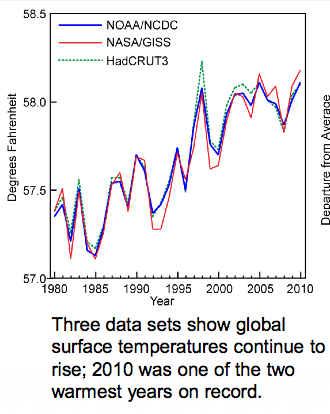
These data show what has happened with global average temperature over the past 30 years...again, there is year-to-year variability which is to be expected, but the overall trend is that things are getting warmer.


What about temperature changes in the USA?  This map shows changes in temperature when you subtract the average July maximum temperature for 1971-2000 from the average July temperature for 1981-2000.  The observation is that the western USA is warming significantly, and there is slight cooling in the heartland.


When we look at the same comparison for Winter temperatures though, we see SIGNIFICANT warming across the entire northern tier of states.  In over words, on average, winters are not as cold as they used to be, especially the farther north you go.


These temperature changes also affect precipitation.  Anyone living in the mountain west or southwest can tell you that less rain has been falling over the past years.  The heartland, though, is getting more precipitation.  Changing air temps affect how much water vapor it can hold, that that affects shifts in regional precipitation.


Lastly (for this posting) sea levels are rising.  This is case along most of our coastlines.  Oceanographers have concluded that most of the sea level rise that has occurred so far is the result of thermal expansion...ocean water getting warmer and less dense...rather than the result of ice caps melting...though sea levels will rise even more and faster once that speeds up.

OK, so why does sea level appear to be going down in some areas (e.g., Alaska)?  Those are areas where tectonic forces are pushing the land up faster than sea level is rising.  So it's not that sea levels aren't rising there, it's just that the land is being pushed up faster than sea levels are rising...so it's a relative change.


When you combine the indicators: land and sea average temperatures, ice cap melt area, Arctic Ocean sea ice melt, changes in latitudinal temperatures, shifts in precipitation, and sea level rise, the only conclusion I can reach is that the global climate is changing - warming.  And so far the only viable explanation that climatologists have been able to come up with that explains why this is happening is the influx of anthropogenic greenhouse gases into the atmosphere starting in the 1800s and continuing through today.  

When we remove the anthropogenic contributions to climate, the remaining natural climate forcing factors alone cannot explain our current observed trend of global warming.