Thoughts on the ocean, the environment, the universe and everything from nearly a mile high.

Panorama of The Grand Tetons From the top of Table Mountain, Wyoming © Alan Holyoak, 2011

Friday, September 14, 2012

The flowers are still growing like mad - odd for this time of year in Rexburg, Idaho

I walked through the Ricks Gardens at BYU-Idaho in my way to work this morning, and as I walked through I thought to myself...is it just me, or are the flowers looking especially good for this time of year?  During my lunch break I took another stroll through the gardens, and this is what I saw - flowers in full bloom and still blooming all over the place!

As I walked along I ran into one of our horticulture faculty and our greenhouse manager, so I asked them if it's just me, or are the flowers in particularly good shape for this time of year.  In response they said, "The magic ingredient is heat."  Flowers love the heat. 

Frankly, it's not that unusual any more for our first hard fall frost to hold of now until sometime in October, and we have flirted with the low 30soF only once or twice so far this fall.  As you can see, the flowers are doing great! They are growing, are in full flower, and some are even still putting out new buds.  

I asked if this was unusual, and they both confirmed that even without a hard frost, the flowers don't usually look anywhere near this good most years.

The secret ingredient?  "Heat."  

While it's difficult to link any weather event, like a warmer than average late summer, to global warming, it is fair to say that the current trend in global climate change makes it more likely for summer-like conditions to extend longer than historically normal.  

The gardens look more like mid-July to me than mid- September...


Now I'm wondering...how long the warm days will last.  I guess the only thing to do is to enjoy it while we have it.  

Thursday, September 13, 2012

Record sea ice melt season reduces sea ice extent to only about 50% of its historical average

It's nearly the middle of September, the traditional end of the sea ice melt season in the Arctic Ocean.  The rate of sea ice melt has slowed over the past few days, perhaps signaling the beginning of the end of the Arctic Ocean sea ice melt season for 2012, but it's not completely done yet, and it's been a crazy summer in the Arctic!

Do you see what I see?  The extent of sea ice cover in the Arctic Ocean is WAY smaller now than the 1979-2000 average (orange lines) with only ~51% of the 1979-2000 average sea ice cover remaining today.


Consider this...

The average sea ice cover (extent) in the Arctic from 1979-2000 was about 6.7 million square kilometers.  Right now there is only about 3.45 million square kilometers of sea ice in the Arctic (as shown above).  The area of ice that is MISSING is shown on the map below.  Sea ice extent has NEVER been this low.

How does this compare to the previous sea ice melt record?  The previous sea ice melt record was in 2007.  The dark gray line on the graph below shows the 1979-2000 average sea ice cover.  The dashed green line shows the sea ice cover during 2007, and the blue line shows sea ice cover during 2012.  The 2012 ice melt smashed the 2007 record, with over 750,000 km2 more sea ice melting than in 2007.

Interestingly, the high amount of sea ice melt in 2007 was largely the result of an unusual Arctic weather year.  It had huge high pressure regions over large areas of the polar north, and lots and lots of sunshine, which meant lots of sea ice melting.  In 2012 however weather conditions did not appear to be set up to produce lots of sea ice melt.  There was a major cyclonic low pressure system that produced lots of cloud cover.  And that combined with associated winds normally slows sea ice melt.  But not this year.  It has just apparently gotten too warm overall in the Arctic for that kind of weather system to slow sea ice melt as much as it used to.

Maybe the sea ice melt in 2007 and 2012 were just statistical outliers.  I would have considered that as a possibility...until I saw the data for sea ice in the Arctic for the years between 2007 and 2012.


The graph below shows the sea ice cover data for the years 2007-2012 plus the 1979-2000 average.  An outlier is an observation that falls well outside of the observed long term trend.  What we see when we look at the data is that every year since 2007, and others not shown here, all fall well outside the 1979-2000 average.  But because there are getting to be so many years outside that average they collectively no longer can really be considered outliers.  Instead, they are possibly representing a new trend.
I just read an extremely interesting paper on what is and has been going on in the Arctic with respect to sea ice.  I recommend it highly if you are seriously interested in this topic.

  • Stroeve, J. C., et al. 2012. The Arctic's rapidly shrinking sea ice cover: a research synthesis. Climate Change 110:1005-1027 DOI 10:1007/s10585-011-0101-1

Here is a link to a PDF file containing that paper: 

One of the things I found most compelling in Stroeve's article was the analysis of sea ice extent over the last 30+ years.  The conclusion is that the rate of sea ice loss is no longer linear.  Annual sea ice extents are dropping faster over the past decade than during previous decades.  The upper graph shows the rate of sea ice loss 1979-1998 in blue, and the rate of sea ice loss 1999-2010 in red.  The significant difference in these rates of sea ice loss is worth noting.  Stroeve's paper refers to models that suggest that the Arctic could become ice free in the summer as soon as 30 years from now.    


On the heels of this year's record sea ice melt, however, some climatologists are starting to suggest the possibility of a summer free of ice in the Arctic as soon as 10 years from now.  Yow!

Wednesday, September 12, 2012

Great Blue Heron - Now THAT'S fishing!

My dissertation advisor at UC Santa Cruz was Todd Newberry.  He is a marine biologist, and he is  also an avid birder.  He enjoys leading bird walks and loves it when people have what he calls "Audubon Moments".  This is when someone takes the time to be still and observe nature.

Last week I had a fantastic Audubon moment, well, actually nearly an hour, of watching and photographing a great blue heron as it worked its way along a river bank, fishing as it went.

Great Blue Herons (Ardea herodius) are among the largest birds in North America, often standing over four feet tall.  They are wading birds that eat fish, frogs, or whatever else can fit down their craw.

Anyway, my wife, daughter, and I went to Warm River, ID - one of our favorite day outings.  As we sat and relaxed, snacked and read at the Warm River Campground, I noticed a blue heron among the vegetation and rocks on the other side of the river.  It was slowly picking its way along the river's edge, standing, looking, fishing, and moving on.

Luckily (OK, it wasn't luck), I had my camera in hand and was able to grab some great shots of it fishing.

Here we go...as it came around the back side of a boulder it stopped and looked...Whep!?  Is that a fish?


I better take a second look.  Yep, fish!  I'm going for it!


Yeah, baby!  Got it, but can I hang onto it?


It's a pretty big one...the dang thing could come back on me...I better give it a good shake!


That's enough shaking!  Now I've got shift it around and get this thing headed head-first down the old gullet.


That's better...


Hey, check it out...I really nailed this fish...put my lower bill right through its head!  Now THAT'S fishing!


Now to swallow this slippery thing...now if I can just flip it just the right way around...


Awesome!  First try!  Just like I planned it...


Hack, gnaw, whthreawght...


Check out this pose...and some people out there don't think I'm really a dinosaur!?


Big gulp...man, that's a long way to swallow.


And I'm off...


This was a fantastic time.  I actually saw it catch a couple more fish, and a corn cob!?  Well at least it let the corn cob go.  Good call.  Now if it were a seagull it'd probably still be trying to hack down the corn cob just so another gull couldn't have it.

So there's one of my latest Audubon moments.

Saturday, September 1, 2012

Fish kill on the Lower Teton River, Idaho - 2012

This short article appeared in the the Idaho Falls Post Register today (1 Sept 2012)

*************************************************************

IDAHO NEWS BRIEFLY


Whitefish die-offs puzzle fish experts
POCATELLO (AP) -- State fisheries biologists are reporting an increase in the number of mountain whitefish dying in eastern Idaho streams and rivers.
Idaho Fish and Game experts said the die-off is troubling and they are counting on the public to help figure out why.

The dead fish have turned up in recent weeks on the South Fork of the Snake River and the main stem of the Snake River. Reports of dead whitefish have also come from the Teton and North Fork of the Salmon rivers.

Regional Fisheries Manager Dan Garre said the cause is a mystery. He said it's interesting that the die-off is targeting whitefish typically under 10 inches -- and not trout.

Tissue samples have been sent to a state lab for analysis.
*************************************************************

I read the article, and thought that was sad.  Interestingly I had some time today, and I headed to the lower reaches of the Teton River to do some fly fishing.  This part of the river, just north of the town of Teton, is usually a great destination and usually yields plenty of action, but not today.  I fished for nearly an hour with no luck at all.  I talked to other people also fishing the Teton today and they reported the same thing.

I know there can be slow days fishing, but for no one to have any luck at all is highly unusual.  What was also unusual were all the dead fish in the water along the river banks.  I also saw or heard only three times when fish surfaced.  That was over about a 3-4 hour period when I was fishing and walking the river looking at what I can only call a fish kill.

A fish kill is a situation where some combination of chemical, physical, and/or biological factors push fish beyond their tolerance ranges, killing many.  Well documented fish kills include situations where water temperatures spike or dissolved oxygen levels drop or chemicals are introduced to the water, or a disease hits a population, etc.  No one yet knows what is going on along the Teton, but this is what some spots along the north fork of the Teton River below the diversion dam, north of the town of Teton, Idaho.


There were dead fish all along the north fork of the Teton River between the diversion dam and the bridge of N 2400 E over the Teton River.  There were so many, in fact, that the smell of decaying fish was evident all along that reach of the river.  

That reach of the river is about 0.5 miles long, and I walked, counted, and photographed, all the dead fish I could see there.  Though this was an unscientific survey - just what I could see from the banks of the river - I saw about 100 dead fish.  All but one of these were mountain whitefish, but one was a cutthroat trout.  

The report that the fish kill was affecting only whitefish may have been preliminary, and it's possible that trout are also under environmental stress.  This photo, taken earlier today, shows a dead cutthroat trout near one of the banks of the Teton River - cause of death unknown.


The cause of death of these fishes has not yet been verified, but fish kills are known to have occurred in conjunction with low dissolved oxygen levels, high water temperature, and chemicals that have run off into a river or lake.  

One interesting piece of research (click the URL to see the entire article) on fishes in California reveals that whitefish are more susceptible to warmer water temperatures than trout.  Since this appears to be the case, whitefish may serve well as a "canary in a coal mine" (environmental indicator species) for trout streams and rivers.  I.e., when the whitefish are under stress, the trout may not be far behind.


I don't know what caused this fish kill.  All I know is that I've fished this part of the Teton River for years and I've never seen anything like it!  It's worrisome, and I hope the Idaho Fish and Game can figure out what is causing the fish to die.

Thursday, August 30, 2012

SHARK RESCUE at Seaside Beach, Seaside, Oregon - 28 August 2012

No, it's not rescuing someone FROM a shark, it's actually rescuing the shark!  Read on...

DISCLAIMER AND WARNING:

First - I need to emphasize something: THIS IS NATURE, NOT DISNEYLAND.  Any wild animal, even one under extreme duress like the one described in this posting, lives according to its own rules not ours.  So if you come across ANY wild animal (injured or not) it's always better to leave it alone and give it plenty of space.  It does not know that you may be trying to do it a favor, and it may defend itself or react unpredictably or dangerously.

Second - Do not try this yourself!  Looking back on my experience, I have to say that I was VERY, VERY lucky.  

On Tuesday, August 28, 2012, my wife and I took a morning walk on Seaside Beach, Seaside, Oregon.  We were out and strolling along the shore before 7am.  Like most people we walked and talked, watched the waves roll in, and kept an eye open for a shell, sand dollar, or something interesting that the tide and waves may have washed up.

For those of you who know Seaside, OR, we were well north of the end of the Prom and had made our turn and were walking south along the beach, it was then about 8:30am.  About 100-150 yards down the beach we saw a young gal standing at the edge of the wave wash zone looking at something in the water.  Whatever it was it had fins, pretty good-sized girth, and was at least a few feet long.  At first I thought it might be a stranded dolphin or porpoise pup.  When I ran over and got close enough to see what it was, I had the shock and thrill of my life.  Luckily I had my wife and camera along!

This is what we saw:


This photo shows no scale for size, but based on other photos and using myself in those photos for scale I calculate that that this shark was between 3-4' long, and as you can see, it comes with a full set of teeth.

The shark was being rolled around in the surf and was under obvious and extreme stress, and showing no signs of life.  It was still very flexible though, so perhaps it still had a chance!

At first glance I didn't know exactly what kind of shark this was, but I'd narrowed it down to one of three species: White, Porbeagle (a.k.a. Mackerel), or Salmon shark.  These sharks all belong to Family Lamnidae and have geographic ranges that include the Oregon coast.  Oh, FYI, this family also includes Mako sharks, but this is clearly not one of those!

Anyway, all Lamniid sharks do something called ram ventilation.  That is, they have to swim with their mouths open in order for water to flow over their gills so they can get the oxygen they need.  I had no idea how long this shark had been in the surf, but it was clear that very little water was flowing over its gills - it was almost certainly asphyxiating, and if it couldn't get oxygen soon it would be a goner.

At this point I carefully grabbed it around the caudal peduncle (the part of the body right in front of the tailfin) and carefully hauled it out of the wave wash zone where I could get a look at it.  I was extremely wary that this shark could convulse or thrash around at any time, so I was prepared for that, but it was limp as could be.  This really concerned me.  You can love nature, but IMO it's better to understand and respect it.


This shark was a juvenile.  It had uniform blue-grey coloration above, and white below.  There were no signs of blood or external injury or damage.

I decided that it was probably either a Salmon or Porbeagle shark because the coloration and teeth didn't look right for a white shark of this size.  Juvenile white sharks are much more common along the southern California coast than they are in Oregon, and young whites tend to have a silvery color along their flanks rather than this clearly distinct dark above and white below color pattern you can see in the photo above.

Later, after this experience was all over and we were back in our room, I did some checking and this was definitely a juvenile salmon shark, Lamna ditrops.  Anyway...

At this point there were only two options.  I could just say that since it was showing no signs of life that it was a goner and leave it on the beach, or I could try to get some water going over its gills in an attempt at resuscitation.  Remember, this animal doesn't know that I'm trying to do it a favor, but because it was so lethargic I decided to pick it up and take it back out into the wash zone where there is moving water that is also highly oxygenated - just what it needed!

I picked it up gently but firmly with one hand around the caudal peduncle and another under the pectoral girdle beneath the pectoral fins.  Before I took it back out we took the opportunity to take a few photos.

Here's a shot showing the "business end" of the animal.  This is NOT the time to see "how sharp those teeth really are"!  I was walking on pins and needles.  Even a small shark like this could give you a nasty gash.  BTW, this shark is a female.  You can tell by looking at the paired pelvic fins just in front of my left hand.  They lack projections called claspers that only males have.


OK, one more close up shot and then it's out to the water...


The rust-red discoloration under the lower jaw is a possible indication of lack of oxygen.  This is a sign that the shark was clearly under duress, and unless water starts flowing over the gills soon it'll probably be a goner.


I walked out far enough that the water would be a depth where the shark's mouth would be underwater and I held it, moving its entire body forward and backward in the water as wave after wave came in.  This is similar to what you might do for a trout before you let it go if you are a catch-and-release fisherman.     

Sadly, the shark continued to show no sign of life after some minutes in the water, remaining just like a rag doll.  


I pulled it back up onto the beach (staying well clear of the teeth-end, just in case) and we gave it another look.


This time when we checked it out, it started to show some weak signs of life - flexing its jaws a bit and weak movement of its tail!  By this time there were probably 6-8 onlookers.  

My wife encouraged me to take it back out and try again, and I did.


I look it out into slightly deeper water than I'd been in before and continued trying to get water into the mouth and over the gills.

It still didn't show a lot of signs of life, but I thought, what have I got to lose?  So I gave it a gentle shove, launching it toward deeper water.  Surprisingly it started to beat its tail fin, still weakly, but beating.  We stood and watched it, hoping for it.  It was still swimming weakly, but swimming nevertheless.  It was having a hard time, getting rolled over in the wash zone a couple of times (see the photo series below), but at least it's head was facing into the waves; water flow = life!

In this series of photos you can see the shark getting rolled over a few times in the wash zone.  When you see black, that's its back.  When you see white, that's its belly.


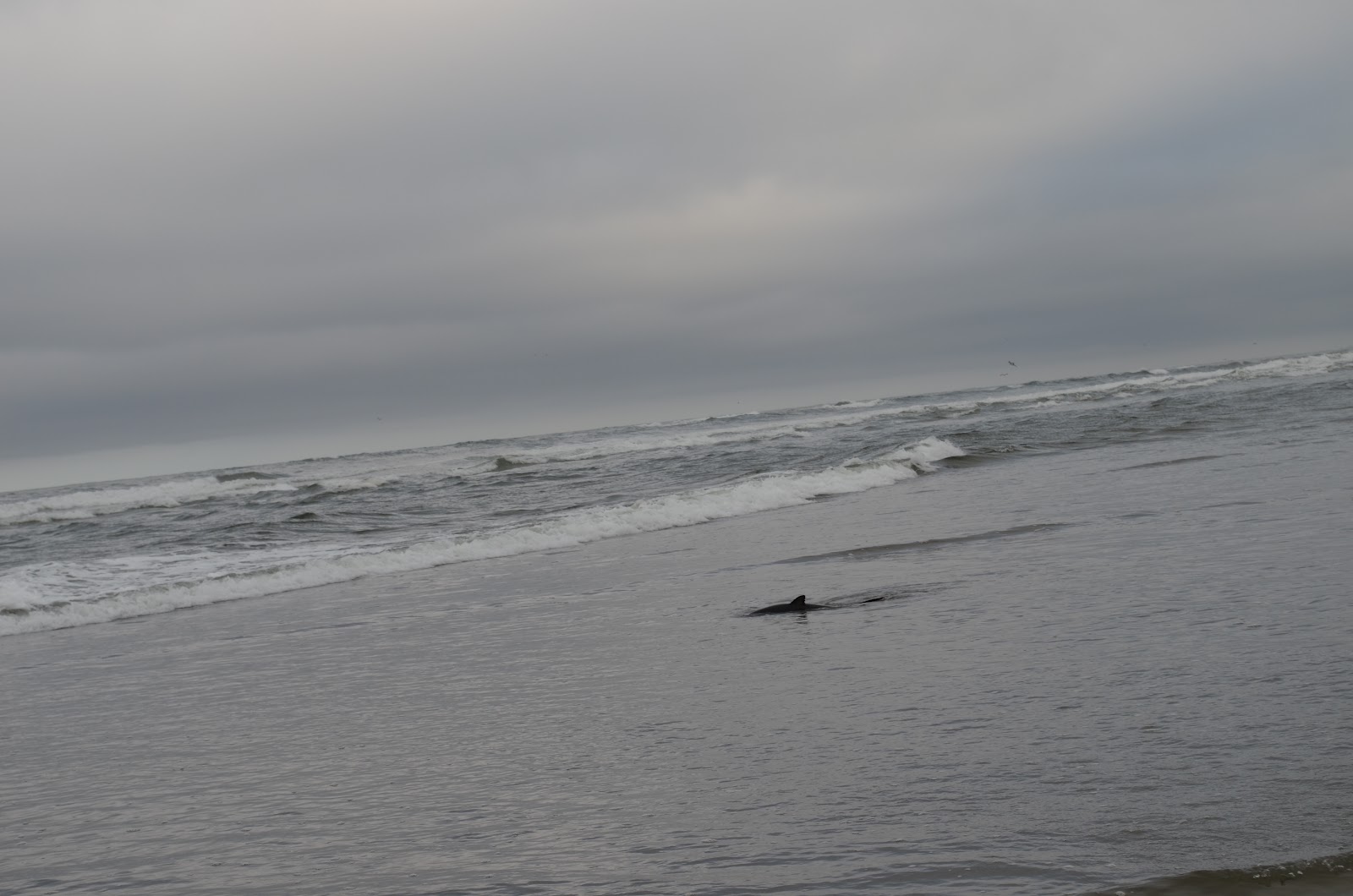
Luckily she managed to get her bearings and make it into deeper water.  If you click on the photo below to see the full-sized image you will be able to see the tips of the dorsal and caudal fins sticking above the water. 


We watched as long as we could, and between 5-10 mins later we couldn't see it any more.  From all indications this was a successful rescue.

FYI, salmon sharks are fish-eaters.  They reportedly prefer salmon.  Their teeth are specialized for this lifestyle.  The teeth are all needle-like, sharp and pointed - good for grabbing and holding a fish, not really so much for biting and slicing - that's the white sharks's game.

Anyway, if you check the web you will see that it is not at all uncommon for salmon sharks, especially juveniles, to get stranded on beaches of Oregon and Washington.

There are a variety of possible reasons why they might get stranded: they could lose their bearings while fishing in shallow water and get rolled up onto the beach; they could be trying to escape from larger sharks (like whites) that are known to feed on this size of shark; or they could be sick and disoriented.  Those are all likely possibilities.  I hope that in this case that the shark was simply disoriented and that she's now fine.

Here's hoping!

Lastly, this is the biggest fish I ever caught!  This is a fish story I'll love telling...

Remember, IT'S NATURE, NOT DISNEYLAND!

And again, remember, I got lucky.  Don't try this yourself!

2012 Arctic sea ice melt sets new record with no signs of slowing down

This is amazing...it's like watching a slow motion train wreck.  You want to look away, but you just can't do it!

The former record Arctic Ocean sea ice melt was set five years ago, in 2007, and though a couple of other years since then looked like they might flirt with setting a new record, none of them really came close.  In October 2007 The National Snow and Ice Data Center reported that the Arctic sea ice had shattered the pre-exisitng record from 2005.  You can read that full report by clicking the link below.

http://nsidc.org/news/press/2007_seaiceminimum/20071001_pressrelease.html

This graph from the NSIDC October 2007 report shows the difference between the sea ice melt in 2005 and 2007.

The dark gray line shows the 1979-2000 satellite data showing the average sea ice extent during those 20 years.  The dashed green line shows the record set in 2005, and the blue line shows the new record that was set in 2007.

The NSIDC analysts concluded that the 2007 record ice melt was the result of a series of weather and other factors including the following:

  • Lower than average sea ice extent at the beginning of the ice melt season
  • Thinner ice than average at the beginning of the ice melt season
  • A persistent high pressure cell over the central Arctic Ocean through much of the melt season.  That high pressure cell meant clearer skies, and increased amount of solar radiation that struck the ice and ocean surface, accelerating melting.
  • Low pressure cells over northern Siberia that produced strong offshore winds that pushed sea ice offshore faster and earlier than normal, plus these winds were warm and promoted further sea ice melt
OK, so what!?

Well, this year, 2012, the Arctic Ocean sea ice melt season still has anywhere from 2 weeks to a month to go, and there is already a new sea ice melt record that from all current indications has the potential to not only exceed, but smash the old record!

This is what the 2012 sea ice melt season looks like so far.

The dark gray line shows the 1979-2000 average, and the dashed green line shows pattern of sea ice melt in 2007, the year of the previous record sea ice melt.  The blue line in this graph shows the sea ice melt pattern for 2012.  If you look at the vertical axis on the left of the graph you can eyeball it and see that the sea ice extent for 29 Aug is probably between 500,000 and 1,000,000 km2 less in 2012 than it was in 2007.  All right, so what were the conditions this year?

The map below shows the maximum sea ice cover of the Arctic Ocean in spring 2012 (18 March 2012). If you look, the sea ice extent is greater than average in the Bering Sea and off Kamchatka.  It reached historical average extents off of the east coast of Greenland and exceeded them off the west coast of Greenland.  At the same time Arctic sea ice cover was below average in the Barents Sea north of Scandinavia and Russia's Kola Peninsula, but not really many other places.


OK, so what conditions existed over the Arctic that led to the current sea ice melt record?

Well, for one thing, there was a strong, cyclonic Arctic low pressure cell that appeared near the end of the first week of August.  Analysts at the NSIDC reported that this type of storm normally spreads sea ice out and slows the rate of sea ice melt, but if you look at the graph of 29 Aug 2009 for the first part of August 2012 the rate of sea ice melt actually increased instead of decreasing!  This is completely counterintuitive when compared to the effects of similar conditions in the past.

This map shows the high and low pressure cells that produced that Arctic storm.  The low pressure cell in the middle of the map should have been a place where cloud cover formed, blocked solar radiation, and produced winds that slowed the compacting of sea ice and sea ice melt...but that didn't happen.


So, to sum up, there was a lot of ice when the melt season began, conditions conducive to rapid sea ice melt were not particularly evident in this year's weather patterns, but a record-setting sea ice melt has already occurred and there are still at least two weeks and perhaps as many as four weeks to go in the ice melt season.

This is what the sea ice cover looked like as of 29 August 2012.  Remember that the orange lines represent the average area of sea ice cover from 1979-2000.  The map speaks for itself.


The only thing we can do now is sit back and see how long the sea ice melt will continue, and by how much the old sea ice melt record will be broken.  Sigh...