Thoughts on the ocean, the environment, the universe and everything from nearly a mile high.

Panorama of The Grand Tetons From the top of Table Mountain, Wyoming © Alan Holyoak, 2011

Tuesday, June 12, 2012

Deals on EBay - I finally decided to let my 35mm film camera gear go


I finally decided to let my film camera equipment go...it is all for sale right now on EBay (through Saturday evening 6/16).  

My basic, all-manual camera - Pentax K1000 (Starting bid = $49.99)


My more sophisticated manual/automatic camera - Canon AE1 (Starting bid = $49.99 or buy it now at $175)


A Vivitar Series 1 VMC 70-210mm f/3.5 macro zoom auto/manual lens with a Canon FD mount. Starting bid is $20.


A Vivitar 28mm f/2.8 wide angle auto/manual lens with a Canon FD mount.  Starting bid = $25.  


My primo macro lens already sold...sorry about your luck on that one!  Just so you know what you missed on that one, it was a Tokina AT-X 90mm macro lens with a macro extender.

Cheers!


Monday, June 11, 2012

"Canary in a Coal Mine" - Arctic Sea Ice

The spring Arctic Ocean sea ice melt is on!

Scientific predictions, observations, and climate models all lead to the conclusion that signs and effects of global warming will be most extreme near the north pole.  I saw some data this morning that made me sit up and take notice.

We are now in the middle of the most rapid sea ice melt of the year.  That's not the news.  The news is that the most recent data from NASA satellites and the National Snow and Ice Data Center (nsidc.org) show a notable drop in the percentage of the Arctic Ocean and nearby waters over the past few days.

Now a few days do not a trend make, but it is worth keeping an eye on!

This map (courtesy nsidc.org) shows two things.  1) It shows orange lines that indicate the historical average limit of sea ice cover in the Arctic Ocean between 1979 and 2000 for this date, and 2) the white area shows the actual sea ice cover for this date.


Just in case nsidc.org isn't one of your favorite web sites, and you don't routinely follow what's going on in the Arctic (I mean, what normal person does?), here's the scoop.  During the winter of 2011-12 there was a larger than average coverage of sea ice in the Bering Sea (west of Alaska and north of the Aleutian Islands) and it hung around longer than usual.  Today's map shows that the Bering Sea ice is breaking up - FAST!  Also, there is quite a bit of open water showing up north of central Canada and central Russia.  So, why the big news?

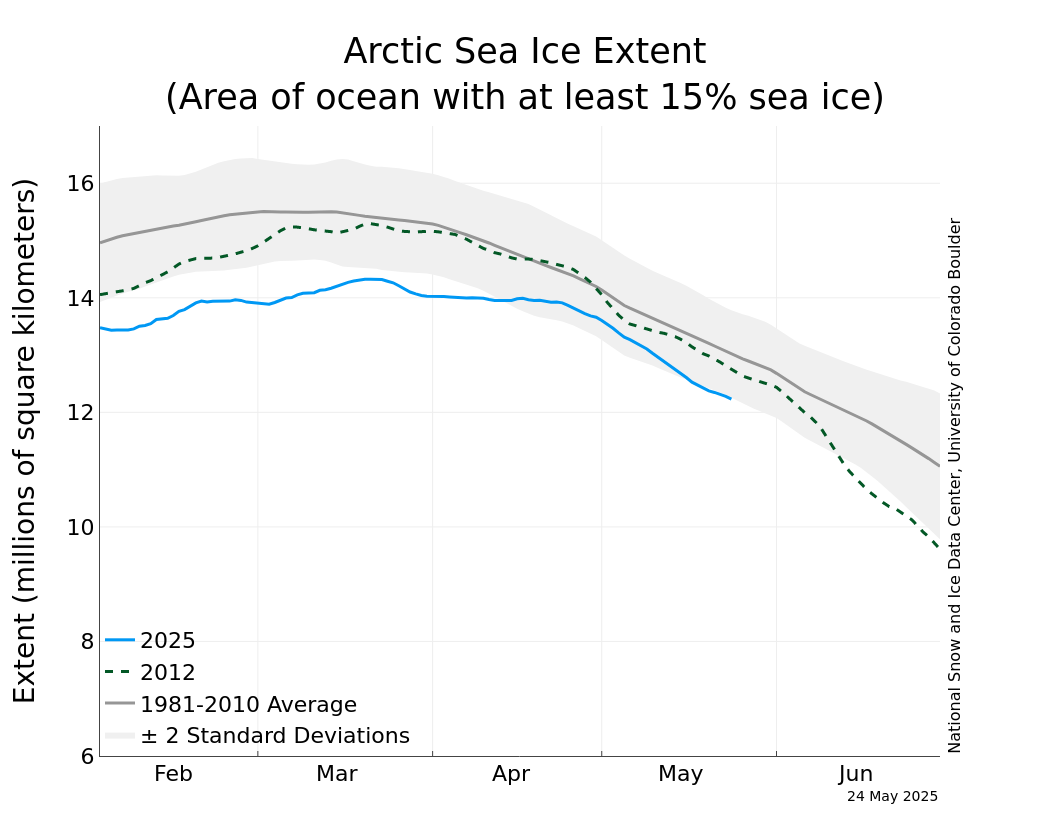
If you take a look at the graph below (also courtesy of nsidc.org), you will see the historical average amount of sea ice cover (1979-2000 - dark gray line), the area containing 95% of all historical observations (1979-2000), the current extent of sea ice cover for 2012 (blue line), and the extent of sea ice cover in 2007 - the year we observed the lowest sea ice extent ever (green dashed line).
OK, so what!?

The sea ice cover for 2012 fell easily within the normal range for historical sea ice cover all spring...until now.  During the past few days the sea ice extent has dropped out of the average range, and even below the 2007 extent.

Does this mean we will see record sea ice melt in the Arctic this year?  There's no way to tell at this point, because wind and weather conditions work together to determine the rate of ice melt and where the ice is blown.  But, these data show that we should keep an eye on the Arctic.  Why?  The overall sea ice cover has taken a short-term dip in total cover.  That may be temporary or it may be the beginning of a rapid melt.  Only time will tell on that one.

Why do I follow what's happening in the Arctic Ocean?  The Arctic is the Earth's climate "Canary in a Coal Mine".  Coal miners used to take canaries with them into the mines.  As long as the canaries sang and were healthy, they knew the air was OK.  But when a canary keeled over, passing out or dying, the miners knew it was time to get out.  This is because the canaries were more sensitive to air quality changes than humans.  Similarly, the Arctic is more sensitive to climate change than other areas of the globe, so when we see changes there - and we ARE seeing changes there, it's time to take notice and make changes to mitigate the problem.

What changes are we seeing?  For one, both winter and summer sea ice cover in the Arctic has been dropping significantly for the past 30+ years!

This graph (courtesy nsidc.org) shows the average sea ice cover for the month of May between 1979 and 2012.  While there is quite a bit of noise (year to year up and down) in the data, the long-term trend clearly shows that there is on average less sea ice in the Arctic in the month of May in 2012 than there was 30 years ago.  The slope showing the overall trend is statistically significant.

By the way, if noise in the data concerns you, you need to realize that EVERY natural system contains noise in the data.  This includes everything from local and global average temperatures to your own heart rate.  But if you collect data long enough, and scientists have, trends, if they exist in the data, will become apparent.  The trend in the Arctic is that it is getting warmer up there, and as a result the sea ice cover is dropping year to year.

In other words, the canaries are having a hard time singing.  They may be having a hard time breathing.

Tuesday, June 5, 2012

North Carolina State Legislature makes it illegal for sea level to rise more than 12" by 2100 (!?)

In this installment of the Colbert Report "The WØRD" is "Sink or Swim", as Colbert's biting and engaging commentary turns to the pesky topic of global warming and sea level rise, specifically as viewed through the red-tinted glasses of the Republican-dominated state legislature of the state of North Carolina.

While hilariously funny in many ways, Colbert's comments expose a situation so pathetic that you have only two choices: laugh or cry.  Listen up...


I've said it before and I'll say it again, one of my favorite quotes is this: "Everyone is entitled to his own opinion, but not his own facts." -- Daniel Patrick Moynihan (Politician and Diplomat).

It's obvious that the North Carolina state legislature is using its own facts AND its own opinion in passing this silly legislation.  I mean, how can you do this!?  

Passing this kind of legislation is the same as legislating whether you will allow the sun to come up tomorrow or whether you will allow a full moon next month.  I guess, on the other hand, I suppose you can pass legislation on anything you want, including legislating the extent of sea level rise  - in this case no more than 8" of sea level rise by 2100.

My question to the NC state legislature is this, "When sea level rise does exceed 8", which it almost certainly will, who are you going to arrest or fine or take other legal action against?"

There's a real brain-scratcher!  You can't cite Nature.  You can't cite the Ocean.  You can't cite the Atmosphere.  But the way things are going right now it's easy to guess what the response will be.  They'll probably try to pin the blame on "that other" political party...

Like I said, it's enough to make you laugh or cry.

"THE WØRD"?  If NC takes only this action, they will eventually have only two options, Sink or Swim!

But seriously, is there such a bill?  And what does it say?

There is such a bill, and here's an excerpt from it:
Lines 11-14 state that the Division of Coastal Management is allowed to use only historical data from 1900 and apply only a linear rate of sea level rise in planning.  Huh!?

The reason this is incredibly wacky is because all climate change and sea level rise models (and these models are based on historical data and current observable trends) show that sea levels almost certainly will not increase at a linear rate, but sea level will rise at progressively increasing rates.

So much for science, I guess...who needs science when you can pass a law?

Thursday, May 31, 2012

Are you an environmental activist?

In some circles "environmental activist" are fighting words.  Don't ask me why...they just are.

I am a normal guy...relatively speaking.  I have never participated in an environmental protest or rally, taken direct action against any individual or company because I felt that they are acting environmentally irresponsible, or done anything like that.  Yet, I am an environmental activist.  I admit it, happily!

Are you one too?

Before you reach for your gun, consider this.

I am a marine biologist by training and a college professor by occupation.  Over my 20+ years teaching at the college/university level I have spent my time teaching courses that focus on the diversity and ecology of life on earth, as well as courses that either focus on or include attention to environmental topics and issues.

Because of that background, I am sometimes asked to talk to public school groups, campus student groups, and even Church groups or Boy Scouts about the environment and environmental issues.  In many cases these groups are not likely to consider themselves to be environmentalists or even environmentally friendly.  When that happens, what do you do?  I'll tell you what I do...I make a statement and then I ask a few questions.

First of all, I tell the group that I'm highly confident that almost everyone in the room, if not everyone in the room, is an "environmental activist."  It's fun to see the reactions to that.  Some people become immediately offended and want to argue right off.  But, rather than do that, I just ask the group to consider a few questions, and I ask them to raise their hand if they have ever done any of these things:

  1. Have you ever recycled anything?
  2. Have you ever picked up trash that was not yours or that was not on your property and thrown it away?
  3. Have you ever made a conscious decision to walk or ride a bike rather than drive your vehicle to get someplace?
  4. Have you ever taken a short shower or turned the water off while shaving or brushing your teeth in order to conserve water?
  5. Have you ever made a decision as a consumer to buy a particular product because it is more environmentally friendly than the alternative? (Think dolphin-safe tuna, or products made from recycled materials, etc.)
  6. Have you ever made a decision as a consumer to not patronize a particular company or store because you do not consider them to be environmentally responsible?
By the time I've asked the first 2-3 questions just about everyone in the room has raised their hand at least once.  After I've asked the questions I stop, shrug my shoulders and tell them, "I'm sorry, but if you raised your hand least once, you ARE an environmental activist."


It then gets REALLY interesting.  I explain that all it takes for someone to be an environmental activist, in my opinion, is for them to make any active decision that is environmentally friendly.  I'm not saying that people are environmental extremists or eco-terrorists, just that they may be more of an environmental activist than they previously thought they were.  It's fun!

In my opinion, everyone should be an "environmental activist", at least as I define it.  If we can do something that benefits the environment, we should do it.  When large numbers of people do the small things we can all do, it adds up.

So, ARE you an environmental activist?  I'll bet you are!

Here's to environmental activists everywhere!  Including you!

Tuesday, May 22, 2012

The Joplin, MO, tornado struck one year ago today.

One year ago today an EF5 tornado tore through Joplin, Missouri.  The loss of life and property was devastating!

The St. John's Hospital in Joplin suffered significant damage from the tornado.  The hospital is shown in the background.  Most of the windows were blown out, and there was massive damage.  Yes, that's a helicopter in the foreground, possible a medivac rescue helicopter.


This is a closer view of one wall of the hospital showing the windows that blew out when the tornado hit.


This video footage is from a security camera inside the St. John's Hospital, and it captured what it would have been like to be in that waiting room when the tornado hit.  This video was posted today, one year after the tornado struck, by the Huffington Post (Huffington Post Joplin, Missouri, Hospital video footage, 22 May 2011).


For more info on this tornado and why tornados tend to form in the Great Plains and Midwest you can check out a posting I made a few days after the tornado struck back in 2011.  You can see it at Thoughts on the Joplin, MO, and Longdale, OK, tornadoes.

So what's happening with the Arctic Ocean melt, May 2012?

The annual Spring-Summer Arctic Ocean sea ice melt is well under way.  Like the past several years, the sea ice extent is below the historical average, though by the end of April the ice extent was still the greatest we've seen for this time of year since 2001.  Even so the NSIDC reported that the rate of ice loss is 2.6% per decade.  In other words...there's less ice up there than there used to be at this time of year, and every year there's getting to be less and less of the the floating white stuff!

The Arctic Ocean sea ice reached its maximum extent in mid to late March of this year.  The only time in the last five years when the sea ice extent was this large this late in the spring was in 2010 when it reached it's maximum in at the very end of March/very beginning of April.

Graph courtesy of the National Snow and Ice Data Center at the University of Colorado at Boulder. (NSIDC).  

The reason the sea ice extent is so large this year is that we have had colder than average conditions in the North Pacific.  The white area on the map below shows the extent of sea ice cover (at least 15% cover) as of 5/21/2012.  The orange lines show the 1979-2000 average extent of sea ice.  


Take a look at the Bering Sea, west of Alaska and north of the Aleutian Islands.  There's a LOT more ice there than usual.  The same thing is true for areas west of the the Kamchatka peninsula by coastal Russia and north of Japan.  In the north Atlantic, however, the melt is near normal by eastern Canada and Greenland.  It's ahead of normal, though, north of Scandinavia and northwest of the Kara Sea.  

I can't imagine that the ice in the north Pacific is going to last that much longer, but we'll just have to wait and see.

The take-home message?  The melt is underway, and though it's been slower than usual for May, it's still melting faster than average over all.


Tuesday, May 8, 2012

Trees and bees

I had some sadness and some gladness this week.

First the sadness...

My office window looks out across the university campus where I teach.  In the distance I can see mountains that are often snow-topped - nice!  My immediate view, though is made up mainly of a parking lot, a street and a round-about, with a large auditorium in the immediate background.  I can also see part of a green space plus a strip of grass between a road the parking lot in the foreground.

Something was different when I looked out of my window on Monday morning.  It took me a few seconds to figure out what it was though.  Then it hit me - someone had cut down four LARGE blue spruce trees that used to line the street that runs past my building!  The blue arrows in the photo below show about where the ex-trees lived, and they were about as tall as the arrows too.


(I apologize for the grainy photo...the only camera I had was on my computer and I was balancing it with  one hand while I reached down to click the mouse to take the photo...heh heh, no, really!)

There is a new steam line being installed along the right-of-way of the road, and the trees were, alas, in the way.  I am not judging whoever made the decision to cut them down, but it made me sad to see them go.  It's like losing three friends I've had since I got here 10 years ago.  Sigh.

Maybe they've gone to tree heaven.

I know that sometimes a tree just has to go.  They can get too large, too unstable, or diseased and a hazard.  These were, as far as I know, healthy trees...they were just in the way.  Now they are gone, and it makes me sad.

I wanted to know how old they were, so a colleague and I went down there and counted the rings on one of the stumps that was still in the ground.  We counted about 40 rings.  This means that they were probably planted there around 30 years ago.  Sigh.

Now the gladness...


There are two apple trees in our back yard.  I whacked them back quite a bit last winter before the sap started to flow, and I wondered if they would blossom this year.  One tree pushed out only a few blossoms, but the other tree is completely covered!  It's a thing of beauty!


A couple of days ago though, we had a spring frost.  It was 27oF, and I worried that the blossoms would freeze and drop to the ground, and that we'd lose our harvest.

In the afternoon of the next day I went out and walked around the tree.  The edges of the blossoms were slightly curled - caused by the frost - but then I stuck my head up into the tree near the trunk, and heard one of my favorite sounds from nature - bees.

I stepped back and soon saw the bees.  The bees flitted from flower to flower and their pollen sacs were getting full.


I don't know if you know this, but these gatherer bees could mostly care less if you get close to them.  You can get right next to them and watch them work.  It's awesome.

I know at least that there was something in the flowers that attracted the bees, now only time will tell if the flowers avoided enough of the frost to set fruit.  But either way the bees were there, and that was one more thing right with the world.

Trees and bees...